Subterranean moisture dynamics directly dictate insect colonization rates in older Richmond housing stock. Brick-and-mortar pier systems common throughout Church Hill and The Fan pull groundwater upward through…
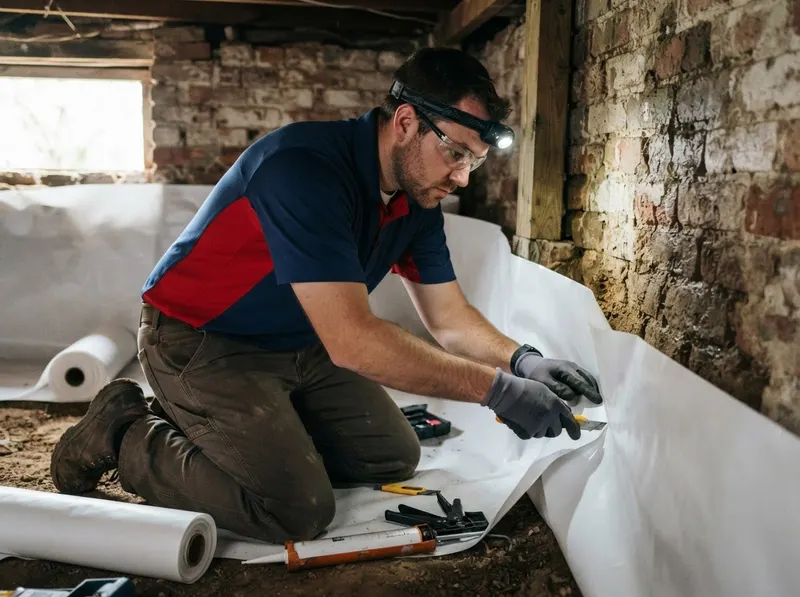
Subterranean moisture dynamics directly dictate insect colonization rates in older Richmond housing stock. Brick-and-mortar pier systems common throughout Church Hill and The Fan pull groundwater upward through capillary action, saturating joists to wood-moisture contents above 20%. This elevation creates an obligate harborage zone for subterranean termites, wood-destroying fungi, and smokybrown cockroaches. Delvixa Pest Elimination installs engineered crawl space barriers that mechanically isolate earth-floor humidity from historic framing. Unlike modern poured-concrete foundations, soft historic brick in neighborhoods like Jackson Ward and Shockoe Slip requires vapor-permeable perimeter borders alongside closed ground barriers to prevent moisture entrapment within early lime mortar.
Selecting a full closed encapsulation versus a reinforced ground vapor retarder depends on relative humidity metrics and perimeter ventilation design. A 12-mil ground vapor retarder addresses direct soil evaporation in properties with adequate cross-ventilation, such as raised cottages in Forest Hill. Full encapsulation, incorporating sealed wall liners, closed foundation vents, and an energy-efficient dehumidifier maintaining relative humidity under 55%, is required when subfloor condensation triggers active mold growth and wood-boring insect activity in high-density Museum District rowhomes. The operational trade-off centers on mechanical reliance: full encapsulation requires continuous dedicated electrical draw for mechanical moisture extraction, whereas an unconditioned vapor barrier provides baseline capillary interruption without ongoing mechanical power.
1. Structural diagnostic: Inspectors measure relative humidity, wood moisture equivalent (WME) across floor joists, and map subterranean entry points along stone or brick ledges. 2. Debris clearing and soil leveling: Organic detritus, cellulose debris, and failed retail plastic are cleared to establish a clean grade. 3. Liner deployment: Continuous sheets of 12-mil to 20-mil multi-ply reinforced poly are rolled across the crawl space floor, overlapped 12 inches, and permanently sealed with heavy mastic tape. 4. Perimeter mechanical fastening: Barrier edges are anchored to foundation masonry walls using expansion fasteners, leaving a continuous 3-inch inspection gap below the sill plate to maintain compliance with Virginia termite inspection standards. 5. Environmental balancing: Penetrations around plumbing stacks and gas conduits are gasketed, crawl vents are insulated, and continuous digital hygrometers are calibrated.
Every job gets a firm, written price after a free on-site visit.
Tell us about your historic foundation encapsulation and moisture barrier job in Richmond and we'll send a clear, written quote, usually the same day.
 Delvixa Pest Elimination